

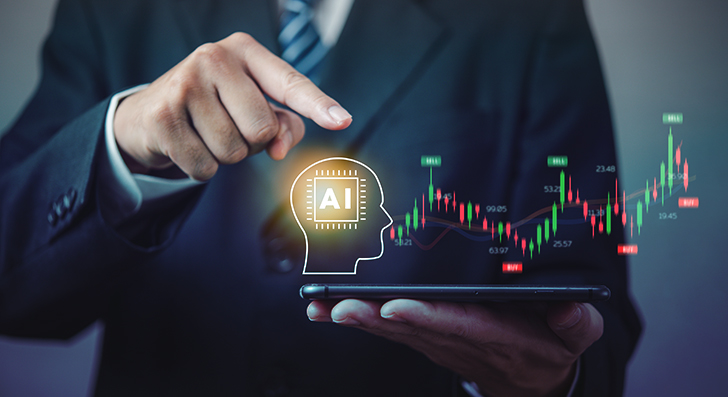
Exploring the impact of AI in predicting stock market trends for retail investors sets the stage for a fascinating journey into the world of advanced technology and financial forecasting. As we delve into the realm of AI algorithms and their role in analyzing data to predict market movements, a new frontier of possibilities emerges for investors seeking an edge in the competitive market landscape.
Throughout this discussion, we will unravel the advantages of utilizing AI in stock market prediction, shedding light on the various technologies that have revolutionized the way we understand and anticipate market trends.
Introduction to AI in Stock Market Prediction
 Artificial Intelligence (AI) plays a crucial role in predicting stock market trends by utilizing advanced algorithms to analyze vast amounts of data. These algorithms can identify patterns, trends, and correlations that may not be apparent to human analysts, enabling more accurate forecasts of market movements.
 AI Algorithm Analysis of Data
AI algorithms in stock market prediction work by processing historical market data, news articles, social media sentiment, and other relevant information to identify patterns and trends. By using techniques such as machine learning and natural language processing, these algorithms can learn from past data to make predictions about future market behavior.- Machine learning algorithms analyze historical stock prices, trading volumes, and other financial data to identify patterns that may indicate future price movements.
- Natural language processing algorithms scan news articles, social media posts, and company reports to gauge market sentiment and predict how news events may impact stock prices.
- Deep learning algorithms can analyze large datasets to uncover complex relationships between different variables and make more accurate predictions about market trends.
Advantages of Using AI for Stock Market Prediction
AI offers several advantages for predicting stock market trends, including:- Ability to process vast amounts of data quickly and efficiently, leading to faster and more accurate predictions.
- Capability to detect subtle patterns and correlations in data that human analysts may overlook.
- Adaptability to changing market conditions and incorporation of new information in real-time for more dynamic forecasts.
Examples of AI Technologies in Stock Market Prediction
There are various AI technologies commonly used in predicting stock market trends, such as:- Random Forest: A machine learning algorithm that can handle large datasets and make accurate predictions by aggregating the results of multiple decision trees.
- Recurrent Neural Networks (RNN): Deep learning models that can analyze sequential data, such as time series stock prices, to predict future trends.
- Sentiment Analysis Tools: Natural language processing algorithms that assess the sentiment of news articles and social media posts to predict how public opinion may impact stock prices.
Data Sources for AI Stock Market Prediction
When it comes to predicting stock market trends, AI systems rely on a variety of data sources to make accurate forecasts. These sources provide crucial information that helps AI algorithms analyze patterns and make predictions.
Historical Stock Data
Historical stock data plays a vital role in AI stock market prediction. By analyzing past stock prices, trading volumes, and other historical data points, AI algorithms can identify trends and patterns that may indicate future market movements. This historical data is essential for training AI models and making informed predictions.
Real-Time Data Feeds
Real-time data feeds are equally important for accurate stock market predictions. These feeds provide up-to-the-minute information on market conditions, news, and events that can impact stock prices. By incorporating real-time data into their analysis, AI systems can react quickly to market changes and adjust their predictions accordingly.
Alternative Data Sources
In addition to traditional stock market data, AI systems can also integrate alternative data sources to improve prediction accuracy. These alternative sources may include social media sentiment analysis, satellite imagery, weather data, and more. By combining these diverse data sources, AI algorithms can gain a more comprehensive view of the market and make more nuanced predictions.
AI Models for Stock Market Prediction

Neural Networks
Neural networks are a type of machine learning algorithm that mimics the human brain's ability to learn. They consist of interconnected nodes that process information and make predictions. In stock market prediction, neural networks can analyze historical data to identify trends and make forecasts based on patterns they have learned.Decision Trees and Random Forests
Decision trees and random forests are popular machine learning algorithms used in stock market prediction. Decision trees break down data into smaller subsets based on different criteria, while random forests combine multiple decision trees to improve accuracy. These models can help identify key factors influencing stock price movements.Natural Language Processing (NLP)
Natural Language Processing (NLP) plays a crucial role in analyzing market sentiment for stock market predictions. By processing and understanding textual data such as news articles, social media posts, and analyst reports, NLP algorithms can gauge investor sentiment and predict how it might impact stock prices.Deep Learning Models like LSTM
Deep learning models like Long Short-Term Memory (LSTM) networks are particularly effective in forecasting stock prices. LSTM networks are capable of learning long-term dependencies in data sequences, making them well-suited for analyzing stock price time series data. These models can capture complex patterns and trends in stock market data to generate accurate predictions.Challenges and Limitations of AI in Stock Market Prediction
AI systems have revolutionized the way we predict stock market trends, but they are not free from challenges and limitations. Let's explore some of the key issues that AI faces in accurately forecasting market movements.Main Challenges Faced by AI Systems
- Complex Market Dynamics: Stock markets are influenced by a multitude of factors, making it challenging for AI models to capture all variables accurately.
- Data Quality and Quantity: AI algorithms require vast amounts of high-quality data to make reliable predictions. Inconsistent or insufficient data can lead to inaccurate forecasts.
- Market Volatility: Sudden market fluctuations can throw off AI models, as they may not be equipped to handle extreme volatility or unforeseen events.
- Overfitting: AI models can become too focused on historical data patterns, leading to overfitting and poor performance when faced with new market conditions.
Limitations of AI Models in Unforeseen Events
- Black Swan Events: AI systems struggle to predict rare, unpredictable events like natural disasters or political crises that can significantly impact stock markets.
- Human Emotions: AI may have difficulty accounting for human sentiments and emotions that can influence market behavior in unpredictable ways.
- Regulatory Changes: Changes in regulations or policies can have a profound impact on market trends, posing a challenge for AI models to adapt quickly.
Risks of Over-Reliance on AI Predictions
- Loss of Human Judgment: Relying solely on AI predictions can lead to a loss of human intuition and critical thinking, which are essential in navigating complex market scenarios.
- Algorithmic Biases: AI models can inherit biases from the data they are trained on, potentially leading to skewed predictions or discriminatory outcomes.
- Technical Failures: Glitches or errors in AI algorithms can result in incorrect predictions, causing financial losses for investors who rely heavily on automated trading systems.
Historical Incidents of AI Prediction Failures
- Flash Crash of 2010: High-frequency trading algorithms exacerbated a sudden market crash, showcasing the limitations of AI in handling extreme volatility.
- Brexit Vote: AI models failed to predict the market impact of the Brexit referendum in 2016, highlighting the challenges in forecasting geopolitical events.
- Pandemic Response: The COVID-19 pandemic caused unprecedented market fluctuations that many AI systems were ill-equipped to foresee, leading to erratic predictions and investment decisions.
Wrap-Up
In conclusion, the integration of AI in predicting stock market trends for retail investors represents a pivotal shift towards data-driven decision-making and enhanced insights. By leveraging advanced algorithms and cutting-edge technologies, investors can navigate the complexities of the stock market with greater precision and confidence. The future of trading lies at the intersection of AI and human intelligence, forging new opportunities and strategies for success in the ever-evolving financial landscape.
Top FAQs
How accurate are AI predictions in stock market trends?
AI predictions can be highly accurate due to the ability of algorithms to analyze vast amounts of data and identify patterns that may not be apparent to human traders.
Can AI predict unforeseen market events?
AI models may struggle to predict unforeseen market events as they rely on historical data patterns and may not account for sudden changes in market conditions.

